
The vendor you're about to bet on can't see the market. Neither can you

Every vendor is sure they know the market inside and out. Guess what? They’re all a little wrong.
I did an interview with Jeff Lawson some 8 years ago. It was an exciting and interesting experience. I remember vividly thinking to myself throughout the experience - who is interviewing who? Me, the CEO of Twilio, or him, trying to get the measure of me.
After the interview, we had a short chat, where he did ask me about joining Twilio. My answer? The main reason I am valuable to Twilio is the one that is lost the moment I join Twilio. Being independent allows me to have a view that is outside any echo chamber that a vendor has.
It was the same even when I worked at Amdocs before going independent. I could feel the discussions and decisions made. They were all framed around how Amdocs is built and works and how its customers are (large telcos the world over). Their view of the Internet giants was… naive… to be frank. The echo chamber of the customers and their vendors here didn’t allow them to look past their noses at what’s coming.
The same is happening in our own small domain of WebRTC, communications and AI.
The Video API report is back, with an AI twist

In the last 3-4 months I’ve been working on an update to the Video API report.
It started after my visit to the US, when in some of the meetings people asked me if/when an update of the report was coming. That was enough of a signal for me that an update is due.
What I didn’t want to do, is to go through the motions of scoring things from the 2nd edition of the report, change a chapter or two a bit and announce it done. It wouldn’t have worked when AI is getting into every aspect of our lives.
So I set out to do something differently. I did my homework, with quite a bit of research. Decided on what to score and how I want to score differently.
Created updated questionnaires, sent them to vendors, reviewed the answers.
In parallel, I conducted my own research - of the market at large - and of the vendors specifically.
All this funnelled into rigorous work in the last month of checking and validating too many numbers and metrics. I even got a few things wrong and corrected them at the last moment.
The result is a report I am proud of.
Here are a few things to know 👇
Every vendor is sure they know the market. They're all a little wrong

I had a couple of email exchanges as well as full on scheduled meetings about scoring. Mostly on the WebRTC tools guide. Vendors weren’t happy with what they saw…
The few mistakes there got fixed.
The rest was me trying to explain that a Claude Code prompt with full context is different than a zero context query using Sonnet or Opus that isn’t allowed to conduct a web search - and that they both are equally important.
That’s exactly the echo chamber effect.
We KNOW things are as they are because that is what we experience.
Here’s a great diagram I should probably put in front of people from now on:
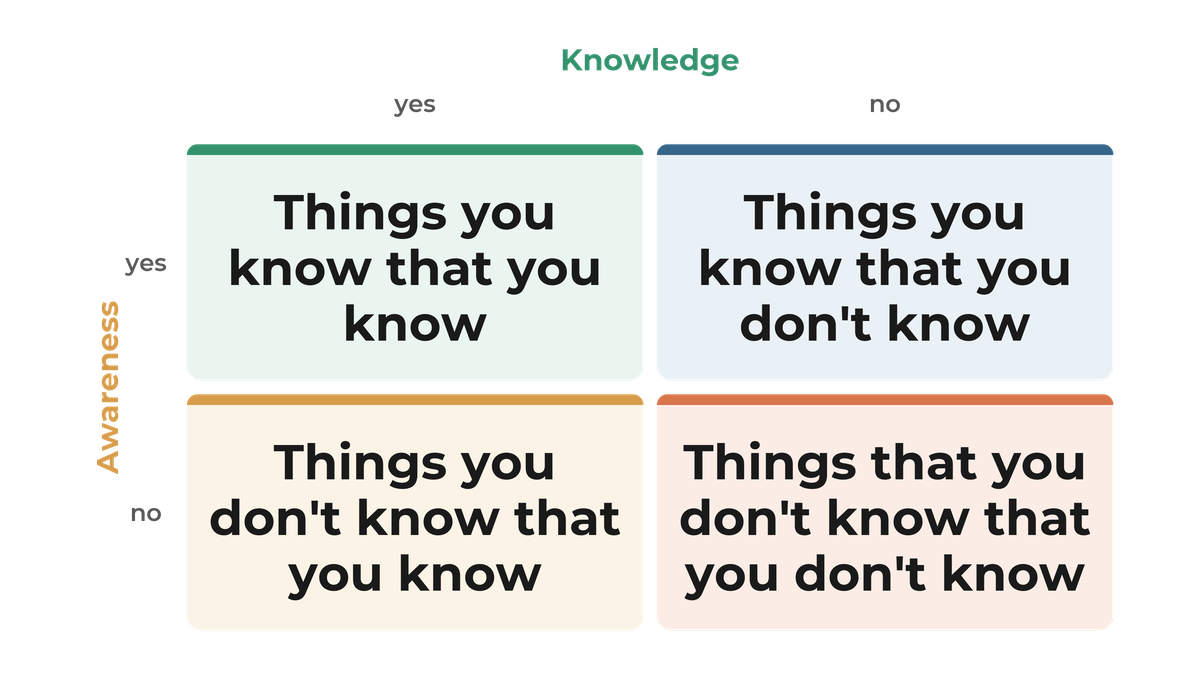
So yes - there are things that you don’t know that you don’t know.
Which is why I am here with this report.
What the echo chamber actually costs you

Here’s the thing. You’ve got an echo chamber, which is something you want in a company - shared understanding, values and goals.
What it does though, is create a blind spot - you see what the company sees. And over time, that becomes even more distinct. People talk about the same topics, read similar news sites and blogs. Share ideas together. And they focus on their daily work, which narrows what they end up reading more often than not.
For example, you know who your customers are, and you know which deals you lost. At times, you’ll even know which competitor you lost. But are you sure all the deals came to you in the first place, or did potential customers not even see you or decided to skip without you knowing?
The opposite is just as true. As a buyer who needs technology… say… a video platform for your application. You’d be doing what anyone would do today - ask AI for its opinion and go with it - or at best shortlist a couple of vendors in its list, trusting its judgement almost fully at this stage.
Problem is, your chances to explain the requirements properly at this step, and a generic AI to give you a suitable shortlist - are both rather low. That’s because the context is not there: You are in the echo chamber of your company and understanding when you frame the prompt(s), the AI has no context beyond what you give it and trained understanding of WebRTC that is incomplete and sometimes a bit dated, and the result is a shortlist that won’t survive scrutiny.
So I mapped the market no one inside it can see

This echo chamber, that blind spot we all have, is what got me to sit down for this update. That and the curiosity to learn more about the intersection between Video APIs and Voice AI.
The way vendors approach it is vastly different. Even when they seem similar from the outside, the technical and business decisions they take, where they place their moat and differentiators vary.
How they appeal to buyers is also quite different.
Pouring into the research, looking at websites, going through answers to questionnaires, talking to the vendors - it has been an interesting experience.
One interesting pattern that the report exposed? The interesting shift in this edition isn't a feature - it's what "winning" now means. The strongest vendors aren't the ones with the best video product, they're the ones other companies build their AI on top of. When Vapi, Retell, ElevenLabs, or a lab like xAI picks whose transport to run inside their own product, that's a very strong signal, and it's a completely different one than many of the vendors themselves are watching.
What's in the report
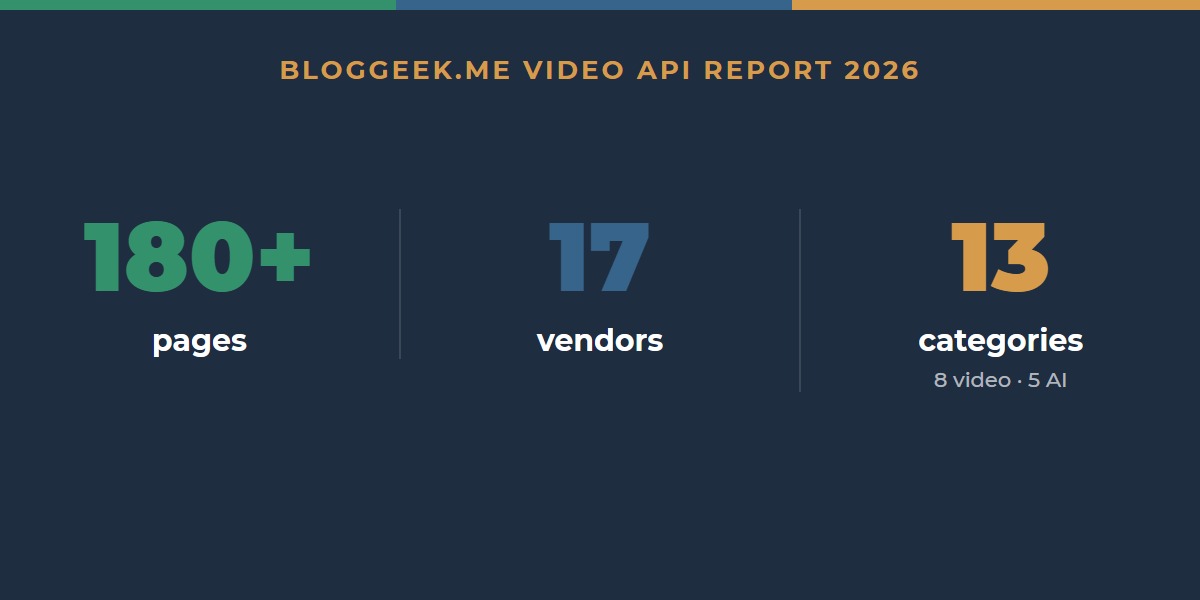
- 180+ pages
- 17 vendors
- 13 categories - 8 Video API related; 5 AI related
Scoring is deterministic, automated a lot more than in previous editions. It was important for me to maintain objectivity here.
You can grab the table of contents and overview (PDF) and read it.
Improving the view, for buyers and vendors both

I’ll close with this.
Here’s what the report aims to do:
- For buyers in this market - spend less time researching and selecting vendors while reducing your risk. I spent the months for you, so you don’t have to
- For vendors who want to see past their own nose - this can be a great outside view for you to use while you plan your strategy and roadmap
Want to learn more? Just check out the report’s page or contact me for more details and questions,

Tsahi Levent-Levi
Independent WebRTC analyst. I help companies ship real-time communications they can actually monitor. 20+ years in the comms space, last 13 focused on WebRTC.
More about Tsahi →