
Beyond Network: How WebRTC and Open Source are Turning Video into a Geopolitical Battleground
WebRTC and open source are turning video into a geopolitical battleground, enabling France's push for digital sovereignty.
WebRTC is getting places. It now plays a minor role in the growing divide between the US and Europe. Apparently, France is rolling out "Visio", its secure and sovereign videoconferencing solution for public officials with an objective to put an end to the use of non-European solutions. Let's dive into the story with an understanding of WebRTC and the ecosystem, to get our own unique view on this.
To start off, you can read the official announcement (in French, translated by Chrome). We will get to it in a moment.
Key Takeaways
- WebRTC and open source are reshaping the geopolitical landscape of video conferencing, as seen with France's 'Visio' initiative for digital sovereignty
- France aims to end reliance on external video conferencing tools, utilizing a homegrown application hosted locally with an emphasis on security
- The shift towards local solutions stems from concerns about data sovereignty, security blunders, and dwindling political trust in foreign vendors
- Open source technologies pave the way for governments to regain control over their communications and data, despite dependencies on underlying US infrastructures
- Challenges remain in developing robust, user-friendly applications while promoting the open source projects governments depend on, raising questions about funding and innovation
France and video conferencing

So… in late January 2026 (last week), David Amiel, Minister Delegate for the Civil Service and State Reform said in a visit that their homegrown tool for video conferencing will be made available to all French state services by 2027.
The intent is to replace the current situation where different government departments use different tools: Teams, Zoom, GoTo Meeting, or Webex. Besides the administrative and price overhead due to this, there’s the reliance on external infrastructure and US corporations.
The solution devised is to build a state owned service and roll it out basing it on French technologies.
Here’s what was highlighted:
- Name of the service/application is Visio
- It has 40,000 active users (if and how much they use it is not divulged)
- Currently being rolled out to 200,000 employees
- Most of the replacement so far is of Zoom seats
- Infrastructure is hosted in France
- Meeting transcriptions (AI) developed by a French startup (emphasizing local sourcing and startup)
- Subtitling will be added in 3-6 months time, by way of another French entity
- The difference in cost is $10 per seat (estimated at €1 million per year for every 100,000 new users switching from licensed solutions)
That last bullet - a million Euros isn’t that much money. It can pay for 1-2 US engineers, and maybe 4-5 in Europe. I am also not sure if that is a coarse calculation that doesn’t take into account things like hosting costs or even the local development costs.
Digging a bit further, France has an initiative of moving towards open source solutions: https://lasuite.numerique.gouv.fr/. This suite includes the usual suspects of Google Worksuite / Microsoft Office - storage, email, documents, spreadsheets, etc. The two interesting initiatives to us: Tchap and Visio
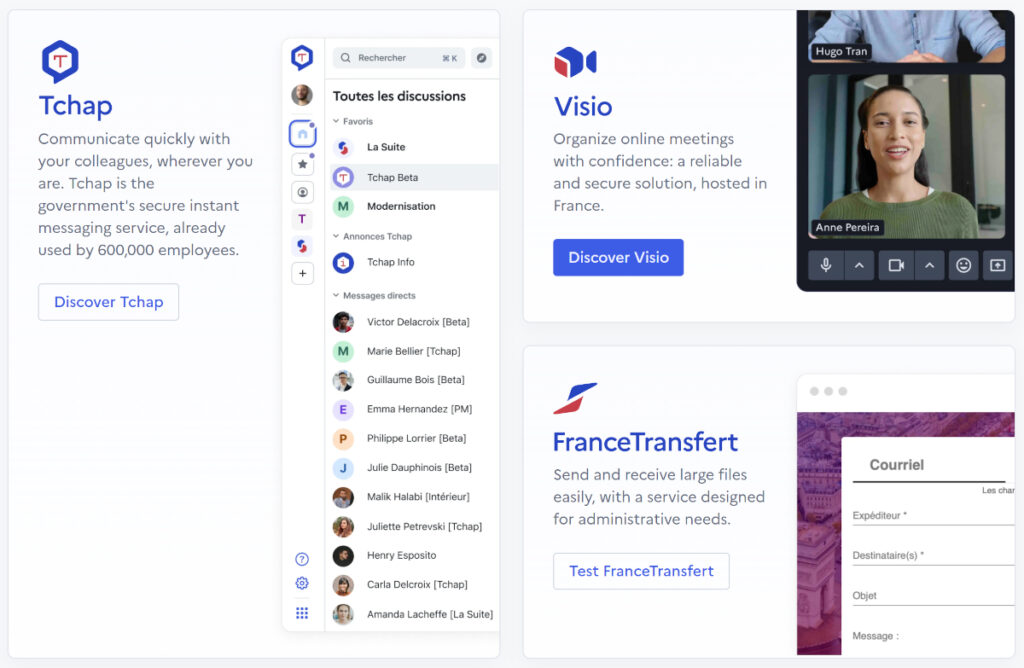
These solutions aren’t built from scratch - Tchap is based on Element (the vendor behind Matrix open source messaging) it seems, with its Visio video conferencing service built on LiveKit’s open source media servers - all hosted in France.
We will look at these solutions/vendors a bit later in this article.
Governance, privacy and security

France isn’t alone. The shift towards the cloud makes many entities nervous as to where their data is stored and processed and under which laws.
In Israel, before the pandemic, I took part in assisting a local vendor in a bid for providing telehealth services through the ministry of health. One of the aspects of that RFQ was the matter of sovereignty - where is the data stored?
At the time, none of the big IaaS vendors had data centers in Israel, which meant that using any one of them translated into having patient health records of Israeli citizens stored in another country.
While that at the time may have seemed fine, today that is unlikely to be the case anymore. During the war raging here in Israel, we’ve seen shipments and services being embargoed by other nations, sometimes arbitrarily.
Having the governmental data and infrastructure of the citizens held hostage by other nations is no longer an option. Not for Israel and likely not for any other country. There are those who say that having a random IaaS (think Google, Amazon or Microsoft) employee in the US being able to roll out an update to your country’s IaaS cloud that disables it or even deletes all its data is not such a farfetched scenario. Not in a world in such a divide as we see today.
This isn’t about taking a political stand - it is just looking reality in the eyes.
It’s a cloudy world out there

The shift towards cloud computing brought with it huge progress and prosperity to the world. It brought many of us closer to each other, whether we like it or not. It made creating new software businesses and applications easier and cheaper than ever before. And it also prodded us further down the road towards a monoculture of services:
- Web browsing? Google Chrome
- Office services? Microsoft Office or Google Workspace
- IaaS? AWS
It isn’t that there aren’t alternatives. They just aren’t as big. Or even close to that.
This monoculture often means a single vendor or a duopoly ruling the whole market globally. And more often than not, that vendor is US based.
For our own small world, Slack came to be some 15 years ago, paving the way for how enterprise messaging needs to be handled. Since then, many vendors followed suit, most with a very similar paradigm and interface.
Into that world, the powers that be of enterprise communications and video conferencing went - Zoom, Microsoft Teams, Google Meet and Cisco Webex. All cloud based. All fit for the enterprise - big or small.
Things might be changing…
Looking for the straw that will break the collaboration camel

Europe needed a way out. Solutions that would take away the stranglehold US companies had on enterprise communications for governmental entities. The main questions were how and when.
We can jot a few important reasons that are getting us closer to that moment. Each on its own isn’t big enough to make the final decision, but together?
Security blunders

There were quite a few security blunders around communications recently. The most public one is likely the German army issues with their own meetings leak to Russia during its talks about/with Ukraine. The service used was a large video conferencing vendor. It was an on premise installation of it. And the breach wasn’t really in the video conferencing part, but rather with the fact that someone connected using PSTN to that meeting.
The noise this made though? It was about video conferencing. And no matter the fact that the service used was installed on premise (which alludes to other concerns of upgrade and security practices for something that is self hosted and self maintained versus a service catering for a lot more users).
Being reliant on an external, non local vendor for security for governments? Unacceptable.
End-to-end encryption

Then there’s end-to-end encryption. The notion that the service provider himself has no real access towards your data. Which is nice. But many vendors were caught in recent years stating that they offer end to end encryption whereas what they meant is an encrypted service - their own employees (or at least some of them) had access when needed to the data of the users.
To that you can add access to the metadata. Element points this out quite succinctly in a post from 2025 about the Swedish Armed Forces opting for Signal on non-classified communications:
WhatsApp can collate user data with other Meta products and doesn’t encrypt metadata.
And more than that - knowing when, how much and with whom someone communicates without knowing the content can still be pretty valuable data to own. I remember this explained to me while I was working at Amdocs: a carrier knows if someone is having an affair simply by knowing his daily route via cell tower connectivity - where he goes after work before heading home…
So yes. We want to have end to end encryption. And privacy. And not have metadata access to anyone. We want it all.
Governance and data sovereignty

Who owns that data?
What happens when the vendor has financial issues or tries to monetize on the data he collects?
How about when a foreign government intervenes, deciding it wants access to data stored within its borders? Data that belongs to citizens of another country…
What’s the legal status of these data and the citizens? Does it even matter at a time and age when the global structures and laws seem to be falling apart?
Countries and organizations are starting to think that the cloud is great, as long as it isn’t too global.
Dwindling political trust

If you live on planet earth for the last decade or so, this is likely something you are already aware of.
Trust in politics is non-existent.
Countries are divided from within and in growing external tensions as well.
This is taking place between adversaries as well as between partners.
The result of this? Governments want more control and ownership over practically everything they can.
WebRTC and open source - turning a service into a feature

In many ways, open source and WebRTC played a crucial role in the ability of governments to switch their communications towards locally sourced vendors.
The early days

Building a video conferencing service was hard. I remember when I worked at RADVISION. Lifesize came out with their revolutionary HD video conferencing unit. They were a startup. And they raised around $70 million (give or take a few millions of dollars) to get that first room system off the ground and into the hands of customers. Europe had the same with Tandberg from Norway, acquired by Cisco in 2010 for $3.4B.
That’s only for one piece of the whole puzzle.
20 years went by. We went from proprietary hardware and proprietary operating systems to Linux and standard CPUs and GPUs.
The next step was moving to PCs running video conferencing as just another “office” application. Until the iPhone came out, and with it the mobile apps that obviously also added video conferencing.
At this point, WebRTC came to be. That brought video conferencing and communications directly to web browsers. And it was open source with a permissive license while at it.
The result? A reduction of barrier of entry and to the development of video conferencing applications.
From a $70 million startup to something you do in the demo/POC before going to investors to ask for a seed round.
Around WebRTC, we started seeing a developer ecosystem build. One that included quite a few open source media servers that became popular. Which is what we’re getting to next 👇
Open source media servers, by country

Interestingly enough, the open source SFU media server origins are quite European…
- Janus has been created and is maintained by Meetecho, an Italian vendor
- Jitsi has its origins in France, by BlueJimp. Jitsi Meet, which is the current flagship product, was originally a French-German cooperation project starting back in 2014. The company was acquired by Atlassian and then by 8x8 from Atlassian. The team has mostly moved to the US, but has roots in Europe. Jitsi itself is a full-blown open-source meeting application suite
- mediasoup’s creators and maintainers are Spanish
- Kurento, prior to the acquisition by Twilio were Spanish. Without the original team, that project died. By again - European in origin
- LiveKit is based on Pion, both originated in the United States
Most of the alternatives on the market for open source media servers are European in nature. The one selected (indirectly) by the French government is the US project. More on that later.
On the client side? Mostly based on Google’s libWebRTC implementation. The majority of that development is done from Stockholm by Google employees. The latest AV1 video decoder integrated into libWebRTC? That would be dav1d, developed mostly in France and sponsored by the Alliance for Open Media with companies from all over the globe, though still predominantly American in nature.
The full stack: messaging and user experience

The media server is one piece of the communications puzzle. The full technology stack requires a messaging service and the user experience on top. These aren’t easy to come by even if they look simple to implement.
As an example, just last month Red5 partnered with PubNub to deliver messaging with its live streaming platform for its video conferencing-style service. You’d think developing such a thing alone wouldn’t be that hard for someone doing live streaming for a living, but guess what - it requires a slightly different skillset and has its own challenges.
The user experience piece isn’t any different. Think of how many sleek messaging apps you know that behave like Whatsapp or Slack - and how many feel a bit klunkier and rougher in the edges. There’s a reason for it. Building a really good UX is hard.
I should know:
- I worked in a video conferencing company, focusing on my own niche of signaling protocols
- Also took part in the due diligence acquisition process of a room system vendor to close a gap we had as a company
- Oh, and was in charge of the project of building a software client built into an LCD display back in the day
- And then there was the standalone PC client we developed as a reference application with all of its nasty edge cases to solve
Different skillsets. Different capabilities. Different challenges.
-
Why am I saying that?
Because today Slack and similar tools are needed for modern office communications. Slack has its competitors. Some of them focused on on-premise and/or strong sovereignty and security.
If you’re looking for such vendors then there’s Mattermost, ownCloud, Nextcloud, Rocket.Chat, … and Element.
Element is what the French government selected to use.
As a company, Element started life as a UK/French initiative - before Brexit. Today, they have offices also in Germany and the US.
For WebRTC, they went with Jitsi (French/US - deciding when you look at it), and then switched to LiveKit (US). which brings us to layers of technology 👇
Sitting on the shoulder of (US) giants

It is great to see countries taking their fate in their own hands. Running their applications on local data centers. Using software written locally on top of open source. Which happens to be written… somewhere. With browsers that are… well… Chromium based (ehm). Using Linux servers (that’s from the US as well I believe). On top of Intel or AMD chips (both American), with GPUs sourced from NVIDIA (anyone said the US?).
But I diverge.
We only wanted to focus on the things I focus on which is WebRTC. Meaning browsers and Chromium and libWebRTC. From Google, obviously. That US based company - Google.
And while libWebRTC is open source, the amount of investment placed in it by non-Googlers is astoundingly low - especially considering the level of use we see for this codebase all over the globe. The majority of the development of libWebRTC is still done in Sweden.
France & made in “Europe”

We recently went to replace some home appliances. We needed a new dryer and kitchen oven. Ended up purchasing also a new induction cooktop, a microwave, airfryer, shaker and electric chopper.
The thing is, we were sitting there with the sales guy. My wife somehow decided that German home appliances are the best (that’s the word of mouth here in Israel), and the sales guy smiles and says - “well… that specific model is assembled in Spain. The other one is in Turkey. What the sticker actually says is that this is German design; and anyways, don’t expect home appliances to have a lifespan of more than 5 years”.
What’s that made in Europe or made in France really mean for software applications?
The elephant in the room - AI agents

All that, without even getting to the fact that everything and anything from now on will be based and driven by AI. Where the US and China are leading the way. And Europe is kinda dragged behind, lagging after the rest at the moment.
The initiative of Visio includes some AI pieces - mostly transcription at the moment. Tablestakes… not innovation. My guess? They’ll end up relying on a US based framework (likely LiveKit Agents) integrated with local algorithms where it makes sense and using whatever else works everywhere else.
Is the French government putting its money where its mouth is? Is it actively promoting the open source projects they rely on, or only paying the outsourcing vendors? In this specific case, France is funding the Matrix project as a Silver sponsor via DINUM. This isn't always the case for large enterprises and governments though:
In a recent article covering this topic, Matthew Hodgson, CEO of Element, had this to say:
Hodgson had assumed that as more governments and corporations started using Matrix there would be more money available for development.
Instead the funding often went to systems integrators hired by governments to deploy Matrix, rather than into Matrix itself.
Matrix is the open source engine behind Element. Apparently, Europe isn’t interested in funding its own open source projects…
In this brave new world of nationalism and each democracy to its own, it will be interesting to see which technology stacks each country will end up with.
Keeping ahead of the crowd

If you are looking and wanting to understand the technologies and the ecosystem better. To keep ahead of the crowd and figure out the best strategy and roadmap for your company, then be sure to check out WebRTC Insights - that’s where we follow such trends (among other things).
Oh, and did I mention that the rtcStats initiative is also based on an open source project? You could say it is kinda multinational, done somewhere in France, Germany and Israel…
And if you’re just looking to have a private workshop or specific consulting - just contact me.

Tsahi Levent-Levi
Independent WebRTC analyst. I help companies ship real-time communications they can actually monitor. 20+ years in the comms space, last 13 focused on WebRTC.
More about Tsahi →