

Let’s look at what we’ve achieved with WebRTC Insights in the past five years and where we are headed with it.

We just entered our 6th year of WebRTC Insights. Along with Philipp Hancke, I’ve been doing this essential, premium biweekly newsletter. Every two weeks, we send it out to our subscribers, covering everything and anything that WebRTC developers need to be aware of. This is used to guide developers with the things important to them. We include bug reports, upcoming features, Chrome experiments, security issues and market trends.
Why should you care? Because this is empowering YOU to make better decisions when developing with WebRTC. You’ll have less surprises and a place to go search for when users complain about weird behaviors.
Key Takeaways
- WebRTC Insights has evolved over five years, providing essential information for developers every two weeks
- The newsletter helps clients save time and stay focused on important WebRTC issues and trends
- Increased improvements this year include a new portal for archived insights and a searchable database
- WebRTC market guidance highlights trends, particularly the rise of Generative AI and its impact on voice AI
- As WebRTC continues to evolve, WebRTC Insights helps developers navigate changes and challenges in the field
Table of contents
How WebRTC Insights really help our clients?
It comes down to two key benefits:
- Time
- Focus
We help engineers and product teams save time by quickly identifying WebRTC issues and market trends. Instead of spending hours searching the internet for clues or trying to piece together fragmented information, we deliver everything they need directly – often several days before their clients or management bring up the issue.
Beyond saving time, we help clients stay focused on what matters most. Whether it’s revisiting past issues, tracking security concerns, understanding Google’s ongoing experiments, or staying updated on areas where Google is investing, we make it easy for them to stay informed.
If I weren’t so humble, I’d say that for those truly dedicated to mastering WebRTC, we’re a force multiplier for their expertise.
WebRTC Insights by the numbers
This is our 5th year. If you are interested in our past summaries, here they are:
- A year of WebRTC Insights
- Two years of WebRTC Insights
- Three years of WebRTC Insights
- Four years of WebRTC Insights
This is what we’ve done in these 5 years:
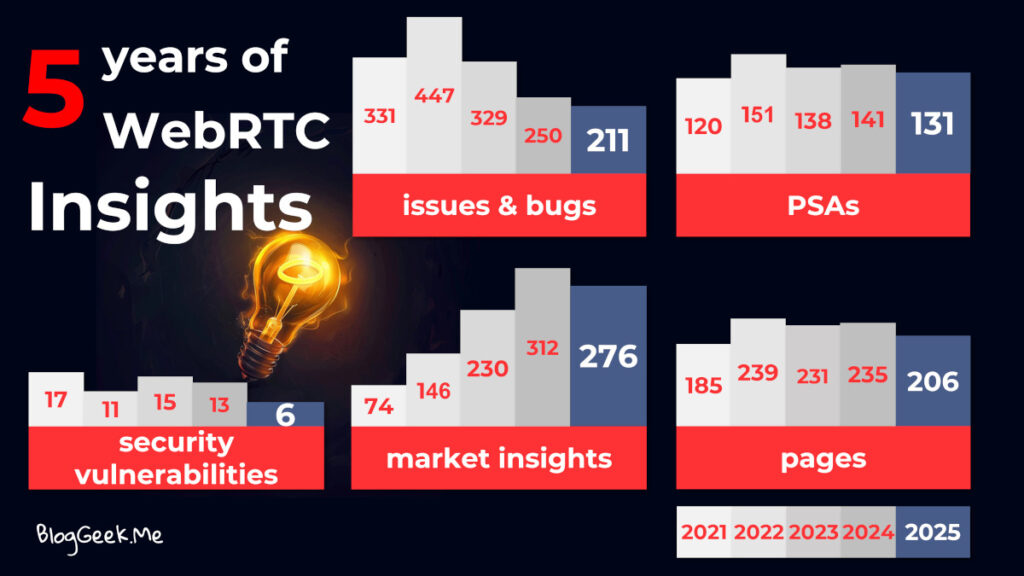
26 Insights issued this year with 211 issues & bugs, 131 PSAs, 6 security vulnerabilities, 276 market insights all totaling 206 pages. A slight decline from last year, though still quite busy for a “maintenance mode” of libWebRTC.
We have covered well over 1,500 issues and written more than 1,000 pages so far.
We’ve grown and improved

This year, we’ve made quite a few improvements to our service.
Up until recently, the service consisted of a simple email sent every two weeks, packed with actionable insights about WebRTC.
While great, it was hard for our clients to maintain their own archive, search historical items, etc.

So we set out and created a portal for the service. In this portal, we now store all archived insights, the latest security tracker document and a few ongoing initiatives that we are tracking (the most recent one being the SDP munging deprecation project taking place in libWebRTC). We’ve sprinkled instructional videos on top, of how to use our Insights service and the portal, getting to where we are today with it.
On top of that, we’ve added two additional powerful tweaks:
- There’s now a “Don’t miss” infobox in each section of the tracker. That’s where we highlight the most important items we’ve found in this issue
- The Insights archive is now searchable using a shared Notion table. You can search for any specific word or term and immediately gain access to all items related to it that were raised in the last 2-3 years. We use it ourselves when we want to refer to older items..
These additions didn’t happen because we wanted them – they took place because our clients asked for them or complained about something they wanted improved. If you are a WebRTC Insights client and you have an idea for us – just let us know 😉
2025…

In the past year, we’ve seen the continued decline in issues and bugs – something we’ve been constantly talking about. The reason is the change in mode of WebRTC towards maintenance, and with it the focus on innovation elsewhere (anyone said GenAI and Voice AI?). Here are the numbers
| Year | Issues we reported on | Issues filed (libWebRTC/Chrome) |
|---|---|---|
| 2020-2021 | 331 | 658 / 579 |
| 2021-2022 | 447 | 549 / 639 |
| 2022-2023 | 329 | 515 / 557 |
| 2023-2024 | 250 | 361 / 420 |
| 2024-2025 | 211 | 324 / 434 |
This correlates with the overall decline in the activity around libWebRTC which has dropped to a less than 200 commits per month these days:
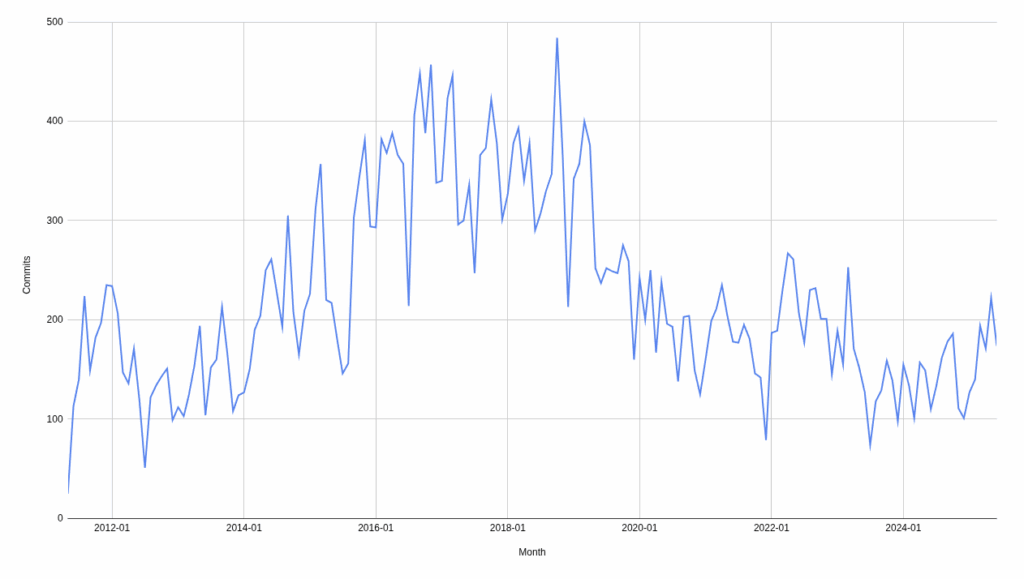
What is surprising looking at these numbers is that the downward trend that we have seen has actually been reversed and there is a slight upward trend.
This is more visible by looking at the last three years (again):
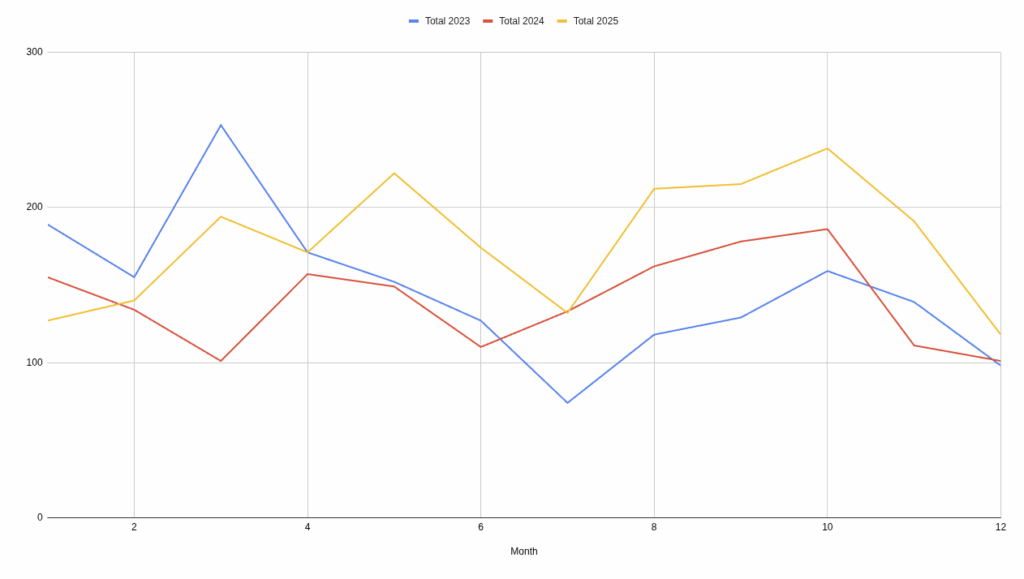
This is still mostly at the level of “keeping the lights on” with some large scale infrastructure changes such as merging the cricket and rtc C++ namespaces into WebRTC. Google contributed (once again) the majority of the work but external contributions have reached a level of 20% now. Given the usage of libWebRTC in browsers like Firefox and Safari the contributions from those amount to less than one percent from Firefox and nothing at all from Apple.
Let’s dive into the categories of our WebRTC Insights service, to figure out what we’ve had in our 4th year.
Bugs

In this section we track new issues filed and progress (in the form of code changes) for both libWebRTC and Chromium. We categorize the issues into regressions for which developers need to take action, insights and features which inform developers about new capabilities or changes to existing behavior and assign a category such as “audio”, “video” or “bandwidth estimation” to make it easy for more specialized developers to only read about the issues affecting their area.
Of course a number of regressions happened. Our favorite this year? A W3C spec change to make the RTP header extension control API more ergonomic broke some servers, including Mediasoup:
Like we said last year, those changes made it all the way to Chrome stable which suggests a lack of testing in Beta and Canary versions. Automated testing in Chrome Beta and Canary remains as important as it has been for the last decade but seems surprisingly uncommon.
We also track progress on feature work such as L4S, corruption detection, DTLS-in-STUN and SNAP (expect some news early next year 🤞). The work on these features often spans months or even years, showing how hard it is to make improvements.
PSAs & resources worth reading

In this section we track “public service announcements” on the discuss-webrtc mailing list, webrtc-related threads on the blink/chromium mailing list, W3C activity (where we often shake our heads) and highly technical blog posts which do not fit into the “market” category.
A good example of this is Google experimenting with a new way to put the device permissions into the page content which we noted in May, followed by seeing how Google Meet put this into action in November. The process for this is “open” but as a developer you need to be aware of what is possible and being experimented with by Google to keep up.
Experiments in WebRTC

Chrome’s field trials for WebRTC are a good indicator of what large changes are rolling out which either carry some risk of subtle breaks or need A/B experimentation. Sometimes, those trials may explain behavior that only reproduces on some machines but not on others. We track the information from the chrome://version page over time which gives us a pretty good picture on what is going on. Knowing what is rolling out currently and might break often given the right context, as we have recently seen in a bug where an applications video started dropping frames excessively beginning with Chrome 140. In the end this turned out to be a bug in how the application handled RTP timestamps but knowing that this area had been changing and how to test was helpful in resolving the issue. Here is what we wrote:
Having the context on when experiments are rolling out is helpful in particular when the behavior is sporadic and does not seem to be happening on all machines with a similar configuration.
WebRTC security alerts

We continued tracking WebRTC-related security issues announced in the Chrome release blog. It has been relatively quiet this year, apart from the OpenH264 CVE and a bugfix by Philipp that got assigned CVE-2025-13639 despite not really being a vulnerability. We also highly recommend the rtcsec.com newsletter and frequently cite it in this section!
WebRTC market guidance

Our market guidance part of the Insights is about what is happening in the bigger world around WebRTC – who is doing what and why. We’re trying to figure out and illuminate trends that are forming and creative moves that vendors are taking.
This year, like anyone else in tech, we’ve seen a huge rise in Generative AI and LLM use. In our case, a lot of it was focused around voice AI, where the intersection with WebRTC and the need for lower latencies is the biggest. We’ve covered here some of the open source AI frameworks used in RTC and how they’ve progressed during the year.
What we’ve also seen is a lot of AI slop when it comes to blog posts of large vendors, mostly from Asia (China if we’re more specific). This slop adds so much noise that the specific vendors are losing attention and focus in our minds, while likely increasing their metrics such as page views.
Anyways, what we’re trying to do here is elevate your understanding of the market, bringing you insights and best practices. Things you need to factor in with your own strategy and roadmap.
Join the WebRTC experts

We are now headed into our sixth year of WebRTC Insights.
Last year we asked ourselves if it would be the last one. I am guessing we will be asking the question again this year, and hopefully, keep on going. WebRTC is still evolving. The codebase, understanding of it and the use cases it is used for. All are shifting. Our role is to keep you ahead of all this.

If you’re working with WebRTC and not subscribed to the WebRTC Insights yet – you need to ask yourself why it is. And if you might be interested, then let me know – and I’ll share with you a sample issue of our insights, so you can see what you’ve been missing out on.