
AudioCodes and WebRTC: An Interview With Yossi Zadah

WebRTC in the hands of a VoIP vendor.
Getting Israeli vendors to interview is a hard task. This time, I managed to get AudioCodes on an interview.
For those who don't know, AudioCodes is one of the companies that have been around since the dawn of VoIP. They have a good reputation and good products. I met Yossi Zadah, Director, Solution Marketing at AudioCodes on several occasions. I enjoyed all of these occasions and took the time to learn from them.
I was happy to get Yossi to answer my WebRTC-related questions.
What is AudioCodes all about?
AudioCodes is a VoIP pioneer. Our products are sold worldwide to service providers and enterprises connecting between different VoIP networks and vendors. We have a rich product portfolio that includes Session Border Controllers (SBC), Multi-Service Business Routers, Media Gateways, Residential Gateways, IP Phones, Media Servers and Value Added Applications.
What excites you about working in WebRTC?
I am a little ambivalent towards WebRTC. On one hand, there is a huge hype and it seems that from a potential aspect, the sky is the limit. On the other hand, as you wrote after the Atlanta WebRTC convention last year, all the applications are Skype look-a-likes and until now, there haven’t been any killer apps.
I believe that in the short term, WebRTC will not replace all the current OTT IM/Social networking applications; my kids will continue using WhatsApp for instant messaging (IM) and Facebook to share posts. In the obvious applications such as contact centers and Unified Federation, the first phase WebRTC will be used partially for audio and file sharing; the video channel has various implications both technically and socially, and it will take time until this technology will be assimilated.
So where is the excitement? Small businesses… Those that don’t have a contact center today, where on the other side of the WebRTC client awaits a craftsman or any other service provider who would greatly benefit from video collaboration to help him/her build familiarity with potential customers. In addition, WebRTC can be relevant in all the applications where video and data sharing are necessary, such as eLearning, remote health consulting, etc.
You decided to add Opus to your IP phones first and only later take care of WebRTC in your SBC. Why is that?
Coders have been our bread and butter for the past twenty years, so naturally we have implemented Opus in our products, first in IP phones, and then in SBCs.
We assume that some use cases, for example, Contact Centers, WebRTC Web Socket, DTLS, and ICE, will be terminated by a WebRTC GW, but in order to maintain the Opus quality end to end and to reduce transcoding overhead, we added Opus to our IP phones.
For those who don't know, AudioCodes is one of the companies that have been around since the dawn of VoIP. They have a good reputation and good products. I met Yossi Zadah, Director, Solution Marketing at AudioCodes on several occasions. I enjoyed all of these occasions and took the time to learn from them.
I was happy to get Yossi to answer my WebRTC-related questions.
What is AudioCodes all about?
AudioCodes is a VoIP pioneer. Our products are sold worldwide to service providers and enterprises connecting between different VoIP networks and vendors. We have a rich product portfolio that includes Session Border Controllers (SBC), Multi-Service Business Routers, Media Gateways, Residential Gateways, IP Phones, Media Servers and Value Added Applications.
What excites you about working in WebRTC?
I am a little ambivalent towards WebRTC. On one hand, there is a huge hype and it seems that from a potential aspect, the sky is the limit. On the other hand, as you wrote after the Atlanta WebRTC convention last year, all the applications are Skype look-a-likes and until now, there haven’t been any killer apps.
I believe that in the short term, WebRTC will not replace all the current OTT IM/Social networking applications; my kids will continue using WhatsApp for instant messaging (IM) and Facebook to share posts. In the obvious applications such as contact centers and Unified Federation, the first phase WebRTC will be used partially for audio and file sharing; the video channel has various implications both technically and socially, and it will take time until this technology will be assimilated.
So where is the excitement? Small businesses… Those that don’t have a contact center today, where on the other side of the WebRTC client awaits a craftsman or any other service provider who would greatly benefit from video collaboration to help him/her build familiarity with potential customers. In addition, WebRTC can be relevant in all the applications where video and data sharing are necessary, such as eLearning, remote health consulting, etc.
You decided to add Opus to your IP phones first and only later take care of WebRTC in your SBC. Why is that?
Coders have been our bread and butter for the past twenty years, so naturally we have implemented Opus in our products, first in IP phones, and then in SBCs.
We assume that some use cases, for example, Contact Centers, WebRTC Web Socket, DTLS, and ICE, will be terminated by a WebRTC GW, but in order to maintain the Opus quality end to end and to reduce transcoding overhead, we added Opus to our IP phones.
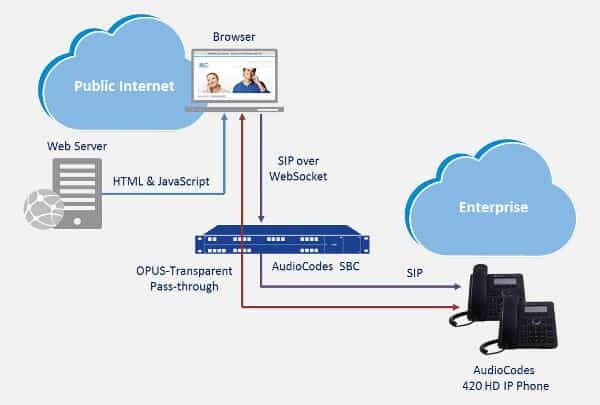
- SIP/WS gateway – to terminate WebSocket from the WebRTC client and convert it to UDP/TCP/TLS to the SIP network
- Media – terminating DTLS/ICE/STUN/TURN, multiplexing, bundle and SRTP to RTP
- Web API for SIP gateway control – using REST API for GW configuration, management and status of the GW
- Transcoding – Opus to other codecs
- Transparent media pass-through – Terminating DTLS and passing voice and video transparently
- Enabling recording – Since all media is passing transparently through the GW, we enable media forking for recording purposes through SIPREC

Tsahi Levent-Levi
Independent WebRTC analyst. I help companies ship real-time communications they can actually monitor. 20+ years in the comms space, last 13 focused on WebRTC.
More about Tsahi →