
popexpert and WebRTC: An Interview With Jeremy Thomas
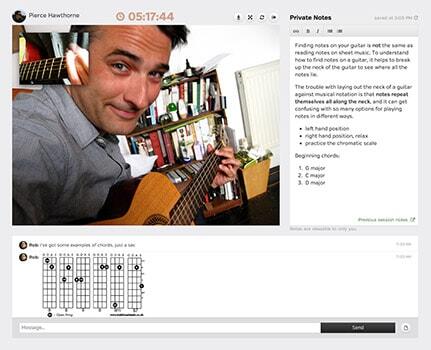
If you are looking at the video experts market, then popexpert is for you.
There are several services out there that are focused at bridging the gap between experts and their customers. popexpert is such a service. The idea behind it is an elegant one: if you search for an expert in any area, search the site, schedule a meeting, and open your browser when the time comes – the service will take care of the rest. From setting up an account, to scheduling, to billing by the hour.
 I was really happy when Jeremy Thomas, CTO and Co-Founder at popexpert took the time to guide me through their service and answer my questions.
What is popexpert all about?
popexpert has a core mission of inspiring and enabling lifelong learning. This mission is manifested through technology that makes experts accessible to people, regardless of geographical boundaries. Booking time with an amazing expert is as easy as booking a meeting through your favorite calendaring system. And we think convenience is very important, which is why popexpert seamlessly integrates scheduling, conversation and payment.
How did you come up with the idea for such a service?
My co-founder, Ingrid, came up with the idea after pulling back from her technology career and taking a six month sabbatical. During this time, she learned meditation and nutrition, and was inspired to make the experts she learned from accessible to others.
I was really happy when Jeremy Thomas, CTO and Co-Founder at popexpert took the time to guide me through their service and answer my questions.
What is popexpert all about?
popexpert has a core mission of inspiring and enabling lifelong learning. This mission is manifested through technology that makes experts accessible to people, regardless of geographical boundaries. Booking time with an amazing expert is as easy as booking a meeting through your favorite calendaring system. And we think convenience is very important, which is why popexpert seamlessly integrates scheduling, conversation and payment.
How did you come up with the idea for such a service?
My co-founder, Ingrid, came up with the idea after pulling back from her technology career and taking a six month sabbatical. During this time, she learned meditation and nutrition, and was inspired to make the experts she learned from accessible to others.
 What worked and what didn't with the integration to WebRTC
We initially implemented WebRTC via OpenTok. I love what those guys are doing. Their bread and butter is in the many to many space, and they had set flags in their implementation for WebRTC to operate via many to many. Chrome 24 shipped with a bug that broke OpenTok's WebRTC implementation (audio would fall out after a short period of time). And they couldn't fix the problem until Chrome 25 shipped.
Waiting for a new release of Chrome to resolve bugs would kill our business. So we decided to roll our own implementation of WebRTC. The difficulty there was in figuring out which reference implementation to use. Some of the demos from the HTML5Rocks article (http://www.html5rocks.com/en/tutorials/webrtc/basics/) are dated. The apprtc implementation is good, but it's built with the assumption that person A calls person B. In our world, we know a session is scheduled to happen between person A and B, but we don't know which one will get there first, meaning we don't know who the initiator is. So we had to build logic into our signaling system where one user is dynamically designated as the initiator.
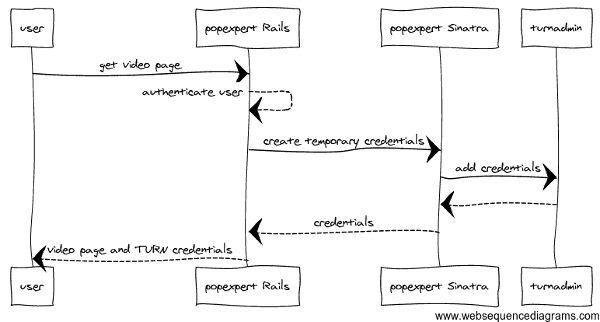
The next challenge was figuring out how to get the TURN server to work. There was no one authoritative source showing how to configure WebRTC on the client-side to work with TURN, nor was there a source showing how to configure the RFC5766 project to work with WebRTC. Getting that to work required a bit of digging.
Finally, we've had intermittent issues with audio where it doesn't work bi-directionally while video works every time. I think I've figured out how to resolve that problem (it looks like a race condition - you need to wait a bit after you call ".addStream" on your peer connection to add your local stream before sending an offer), but that required a lot of trial and error. Really what it boils down to is that WebRTC is so new, and there are so few reference implementations, you're on your own to resolve issues like these.
Given the opportunity, what would you change in WebRTC?
Cross-browser interoperability will be huge for us. I'm excited by what I see coming down the pipeline between Firefox and Chrome. But I'd love to see a more authoritative reference architecture which illustrates how to setup a TURN server, which technologies are good for signaling, etc.
What's next for popexpert?
Next up is focusing on building our marketplace. We may bring WebRTC to mobile natively. But we're more likely to wait for mobile browsers to catch up. We'd also love to partner with Google as a reference implementation.
-
I'd like to thank Jeremy for his time and effort on this one. If you'd like to try out popexpert, you can use their invite link to do so.
The interviews are intended to give different viewpoints than my own – you can read more WebRTC interviews.
What worked and what didn't with the integration to WebRTC
We initially implemented WebRTC via OpenTok. I love what those guys are doing. Their bread and butter is in the many to many space, and they had set flags in their implementation for WebRTC to operate via many to many. Chrome 24 shipped with a bug that broke OpenTok's WebRTC implementation (audio would fall out after a short period of time). And they couldn't fix the problem until Chrome 25 shipped.
Waiting for a new release of Chrome to resolve bugs would kill our business. So we decided to roll our own implementation of WebRTC. The difficulty there was in figuring out which reference implementation to use. Some of the demos from the HTML5Rocks article (http://www.html5rocks.com/en/tutorials/webrtc/basics/) are dated. The apprtc implementation is good, but it's built with the assumption that person A calls person B. In our world, we know a session is scheduled to happen between person A and B, but we don't know which one will get there first, meaning we don't know who the initiator is. So we had to build logic into our signaling system where one user is dynamically designated as the initiator.
The next challenge was figuring out how to get the TURN server to work. There was no one authoritative source showing how to configure WebRTC on the client-side to work with TURN, nor was there a source showing how to configure the RFC5766 project to work with WebRTC. Getting that to work required a bit of digging.
Finally, we've had intermittent issues with audio where it doesn't work bi-directionally while video works every time. I think I've figured out how to resolve that problem (it looks like a race condition - you need to wait a bit after you call ".addStream" on your peer connection to add your local stream before sending an offer), but that required a lot of trial and error. Really what it boils down to is that WebRTC is so new, and there are so few reference implementations, you're on your own to resolve issues like these.
Given the opportunity, what would you change in WebRTC?
Cross-browser interoperability will be huge for us. I'm excited by what I see coming down the pipeline between Firefox and Chrome. But I'd love to see a more authoritative reference architecture which illustrates how to setup a TURN server, which technologies are good for signaling, etc.
What's next for popexpert?
Next up is focusing on building our marketplace. We may bring WebRTC to mobile natively. But we're more likely to wait for mobile browsers to catch up. We'd also love to partner with Google as a reference implementation.
-
I'd like to thank Jeremy for his time and effort on this one. If you'd like to try out popexpert, you can use their invite link to do so.
The interviews are intended to give different viewpoints than my own – you can read more WebRTC interviews.
I was really happy when Jeremy Thomas, CTO and Co-Founder at popexpert took the time to guide me through their service and answer my questions.
What is popexpert all about?
popexpert has a core mission of inspiring and enabling lifelong learning. This mission is manifested through technology that makes experts accessible to people, regardless of geographical boundaries. Booking time with an amazing expert is as easy as booking a meeting through your favorite calendaring system. And we think convenience is very important, which is why popexpert seamlessly integrates scheduling, conversation and payment.
How did you come up with the idea for such a service?
My co-founder, Ingrid, came up with the idea after pulling back from her technology career and taking a six month sabbatical. During this time, she learned meditation and nutrition, and was inspired to make the experts she learned from accessible to others.
turnserver -o -X xx.xxx.xx.x --no-tls --no-dtls -a -b turnuserdb.conf -f -r popexpert.com{iceServers:[{ url: "turn:" + turnUserName + "@" + turnServer, credential: turnPassword },{url: "stun:stun.l.google.com:19302"}]}
Tsahi Levent-Levi
Independent WebRTC analyst. I help companies ship real-time communications they can actually monitor. 20+ years in the comms space, last 13 focused on WebRTC.
More about Tsahi →
Fabulous article. Does anyone know if the VP8 implementation in the most simple environment of a Chrome browser communicating with another chrome browser supports 100% reliable full duplex. Meaning both parties can talk continuously at the same time and there are not audio drop outs due to things like echo cancellation getting activated?
Scott,
VP8 is a video codec. The questions you ask are around the voice codec - and more precisely about the algorithms and voice engine around it.
The voice engine used in Chrome comes from Google's acquisition of GIPS, which at the time of acquisition was one of the best in the market.
I hope this helps...
Tsahi
This is even more complicated than I thought. Is the voice codec choice separate from the video codec choice? In WebRTC does the browser choose there own voice codec? Or is the GIPS based voice codec assumed to always be linked with the VP8 video codec.
Do you know someone who is an expert on this issue and full duplex capability of the GIPS based audio codec?
Thank you.
Scott,
This is relatively unrelated to this post. I'll try to follow up on it with you via email.