
WIT Software and WebRTC: An Interview With André Silva

WebRTC at the hands of a telecom vendor.
The Telecom world has its own set of standards and needs. At times, they seem far remote from the way the Internet and WebRTC operates.
How do you bridge between the two? André Silva, Team Leader & WebRTC Product Manager at WIT Software tries to explain in this interview.
What is WIT Software all about?
WIT is a software development company specialized in advanced solutions for mobile telecommunications companies. The company has over 14 years of experience and a deep expertise in mobile communications and network technologies including IP Multimedia Subsystem (IMS), mobile voice (Mobile VoIP and Voice over LTE), messaging (SMS, MMS and IM), Rich Communication Suite (RCS) and Multimedia Telephony Services (MMTel). Located in Portugal, UK, Germany and California, the company has over 230 fulltime employees and a blue chip industry client base.
You've been working in the Telco space offering IMS and RCS products. What brought you towards WebRTC?
Back to 2008, WIT started the development of a Flash-to-SIP Gateway to support voice calls from web browsers to mobile phones. The first commercial deployment was done in 2011, enabling calls from a Facebook App to mobile subscribers connected to the Vodafone Portugal network. This first version included features like enhanced address-book, presence, IP messaging, IP voice calls and video calls.
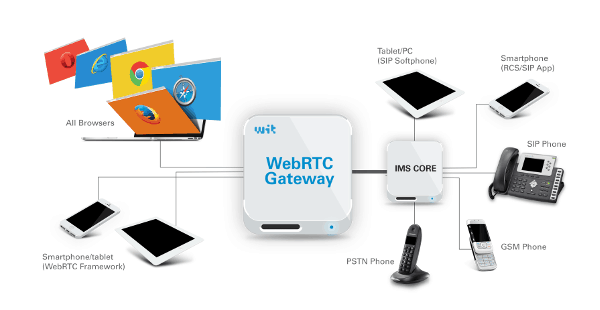
When Google released the WebRTC project back in 2011, WIT started following the technology and as soon as it got stable we have implemented a new release of our Web Gateway with support for all the browsers in the market, including Chrome, Firefox and Opera that are WebRTC-compliant, but also Safari and IExplorer where we use the Flash-to-SIP capabilities.
How are your customers responding to the WebRTC capabilities you have?
Our customers are searching for ways to extend their mobile/fixed networks to web browsers and IP devices, either to extend voice calling with supplementary services and SMS, or to make more services available to off-net users. We are providing our WebRTC Gateway and our RCS capabilities to provide richer messaging and voice calling use-cases for the consumer and the enterprise market.
One of the facts that is much appreciated is the support for non-WebRTC browsers. The conversion of protocols (DTLS-SRTP and RTMP) to RTP is done by our Gateway and it is transparent for the network.
For codec transcoding, we support the standard JSR-309 to integrate with MRF’s in order to support extra codecs that are not natively available in WebRTC.
Recently we just announced a partnership with Radisys that is a leading provider of products and solutions, to address emerging media processing challenges for network operators and solution vendors.
How do you bridge between the two? André Silva, Team Leader & WebRTC Product Manager at WIT Software tries to explain in this interview.
What is WIT Software all about?
WIT is a software development company specialized in advanced solutions for mobile telecommunications companies. The company has over 14 years of experience and a deep expertise in mobile communications and network technologies including IP Multimedia Subsystem (IMS), mobile voice (Mobile VoIP and Voice over LTE), messaging (SMS, MMS and IM), Rich Communication Suite (RCS) and Multimedia Telephony Services (MMTel). Located in Portugal, UK, Germany and California, the company has over 230 fulltime employees and a blue chip industry client base.
You've been working in the Telco space offering IMS and RCS products. What brought you towards WebRTC?
Back to 2008, WIT started the development of a Flash-to-SIP Gateway to support voice calls from web browsers to mobile phones. The first commercial deployment was done in 2011, enabling calls from a Facebook App to mobile subscribers connected to the Vodafone Portugal network. This first version included features like enhanced address-book, presence, IP messaging, IP voice calls and video calls.
When Google released the WebRTC project back in 2011, WIT started following the technology and as soon as it got stable we have implemented a new release of our Web Gateway with support for all the browsers in the market, including Chrome, Firefox and Opera that are WebRTC-compliant, but also Safari and IExplorer where we use the Flash-to-SIP capabilities.
How are your customers responding to the WebRTC capabilities you have?
Our customers are searching for ways to extend their mobile/fixed networks to web browsers and IP devices, either to extend voice calling with supplementary services and SMS, or to make more services available to off-net users. We are providing our WebRTC Gateway and our RCS capabilities to provide richer messaging and voice calling use-cases for the consumer and the enterprise market.
One of the facts that is much appreciated is the support for non-WebRTC browsers. The conversion of protocols (DTLS-SRTP and RTMP) to RTP is done by our Gateway and it is transparent for the network.
For codec transcoding, we support the standard JSR-309 to integrate with MRF’s in order to support extra codecs that are not natively available in WebRTC.
Recently we just announced a partnership with Radisys that is a leading provider of products and solutions, to address emerging media processing challenges for network operators and solution vendors.

Tsahi Levent-Levi
Independent WebRTC analyst. I help companies ship real-time communications they can actually monitor. 20+ years in the comms space, last 13 focused on WebRTC.
More about Tsahi →