
Twilio SIGNAL 2026: the pivot from CPaaS to conversation infrastructure
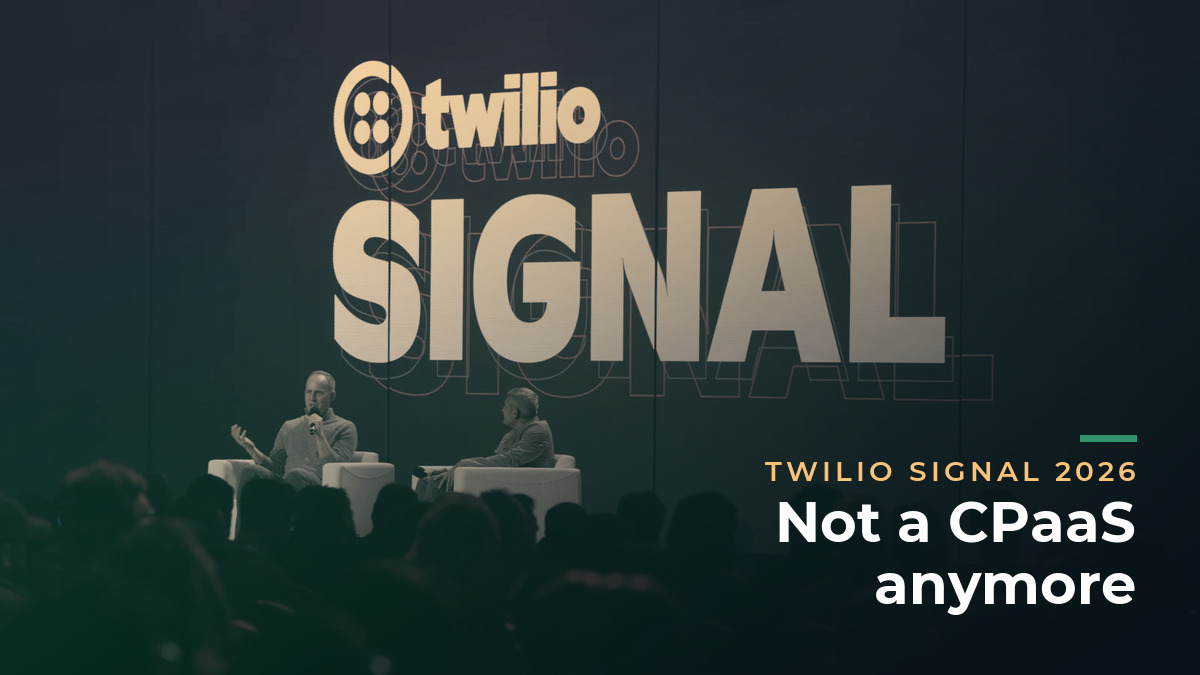
Twilio just told the market it doesn't want to be a CPaaS anymore.
It never really did. The term "CPaaS" was never something that Twilio embraced, or that Jeff Lawson, their co-founder and former CEO, warmed to. That said, their focus shifted away from CPaaS, at least on the marketing and management side.
That's the main message out of SIGNAL 2026, held in San Francisco on May 6-7. Not a media feature. Not another channel. Not expansion of the network or deliverability. A repositioning. The conference theme on stage was "Build Wonder," but the launch underneath it was pure infrastructure. Twilio's own framing for the product news was "infrastructure for the agentic era," and the line doing the heavy lifting was: "AI isn't the problem, infrastructure is."
Strip away the keynote polish and here is what they are betting on: the gap in AI customer experiences isn't the model. It's connecting that model to real customers, across real channels, with real context. Twilio wants to own that connecting layer.
Up until its Segment CDP acquisition years ago, Twilio dealt with the here and now - how do you send and receive messages, calls and video meetings as efficiently as possible. The Segment acquisition positioned it to collect and own the data of its customers. Linking the two was a multi-year work, and now, they are laying AI on top and inside that data, turning Twilio into its customers' brain when it comes to their own customer interactions.
Let me walk through what they launched, what it means for those of us who care about WebRTC, and the part nobody on stage wanted to dwell on.
The Conversation Layer is Twilio now
The launch was built around what Twilio calls the Conversation Layer. Three products that sit on top of the channels Twilio already runs (Voice, SMS, WhatsApp, RCS) and add context, memory, and orchestration for AI agents:
- Conversation Orchestrator routes interactions across channels without you writing the glue logic. It treats the conversation as the system of record, not individual channel sessions, and it keeps context across AI-to-human handoffs. No re-architecture, it works within your existing Twilio channels
- Conversation Memory is identity-resolved customer profiles, tuned for LLMs to cut latency and token usage. It ships with an Enterprise Knowledge API for grounding agents in your FAQs, policies, and product docs
- Conversation Intelligence runs real-time analysis on live calls. The word that matters here is "real-time" - sentiment detection and escalation flags mid-conversation, not post-call analytics read later
Every one of these makes Twilio more central to your AI agent. Every one is about making use of storage and data. That's not an accident, and I'll come back to it.
WebRTC and Twilio in 2026
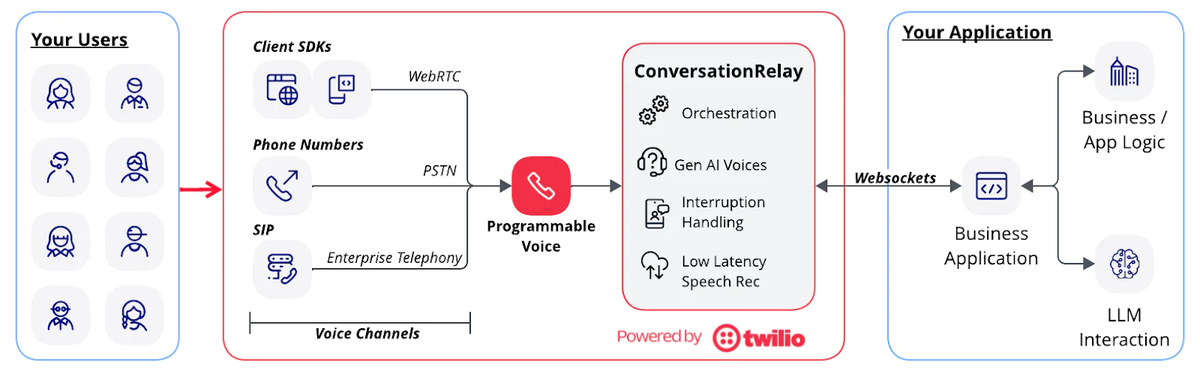
For those of us watching the media stack, the relevant piece is Conversation Relay and its enhancements. As a reminder, Conversation Relay combines STT, TTS, and your LLM of choice, orchestrated over a WebSocket API, hooked into Twilio Programmable Voice. Which means it runs over PSTN, SIP, and WebRTC through the Twilio Voice JavaScript SDK.
What they added:
- PCI and HIPAA. Make it suitable for healthcare and other governance-rich industries
- Deepgram Flux STT, which detects when a speaker finishes, handles natural filler words, and filters out background noise. Turn detection runs on Deepgram Flux, not on a Twilio-built component: Twilio is leaning on its STT partner for the hard real-time signal rather than building it in-house. Twilio's value here is the orchestration and the context, not low-level voice signal processing
- Bring Your Own TTS (pilot), adjustable interruption sensitivity, and a drag-and-drop Conversation Relay widget in Twilio Studio
They also published a tutorial for browser-based voice AI using the Voice JS SDK plus Conversation Relay.
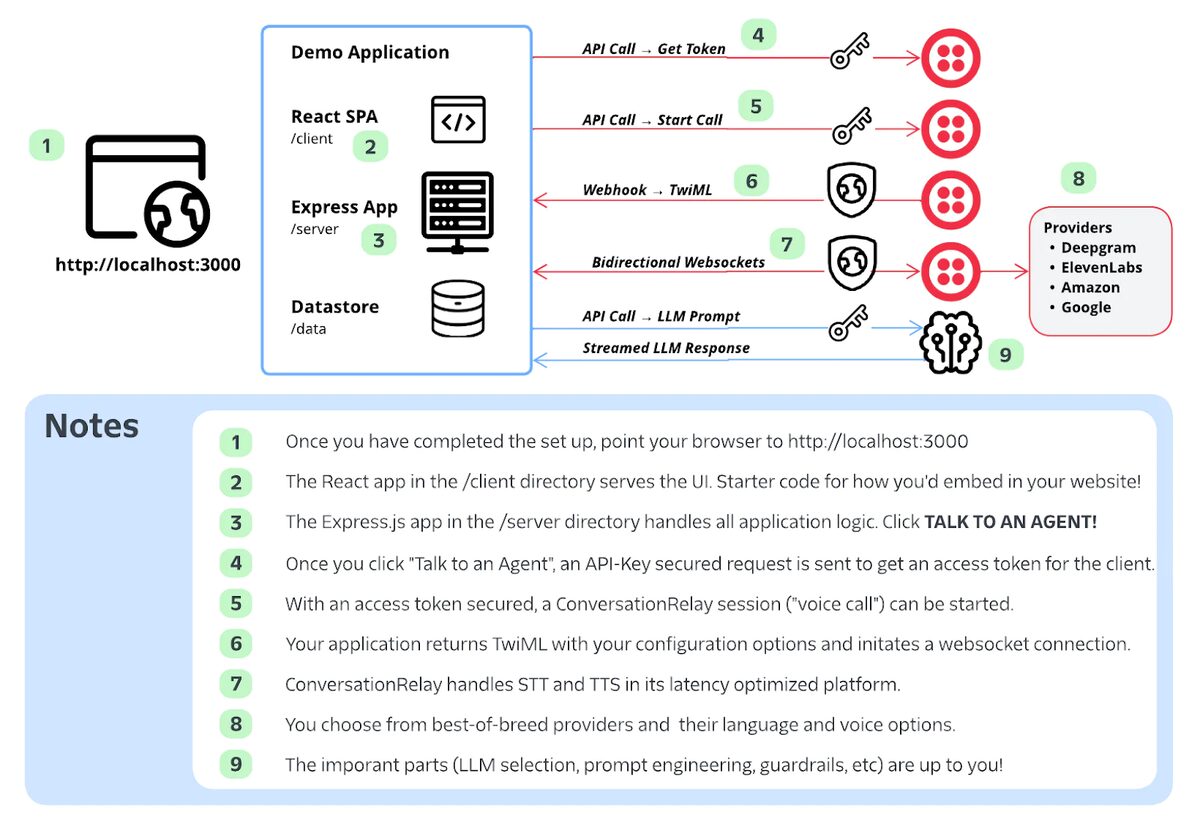
And for the teams not using Conversation Relay, there's Agent Connect, now GA. An open-source, self-hosted SDK in Python and TypeScript that connects any agent - OpenAI, Anthropic, Bedrock, LangChain, your own - to Twilio's voice and messaging channels.
What they did NOT say about WebRTC
Twilio announced no new WebRTC capabilities at SIGNAL. No media processing changes. No codec work. No SFU story. WebRTC showed up as transport - one more way into the voice AI stack, next to PSTN and SIP - and nothing more. That makes sense for an event leaning heavily towards agentic AI in 2026.
Twilio Video is not dead, to be clear. But it got about ten seconds of stage time. Real-time transcription for Video has been GA since late 2025, before SIGNAL, so it is not a SIGNAL launch. That transcription is the hook that lets Video feed Conversation Intelligence. For Twilio, Video's role now is to be another channel into the conversation layer. Ten seconds. Now move on.
If Twilio's Video offering was as rich as their Voice offering, that would be great. But it isn't. It is lagging behind somewhat.
The build vs buy angle nobody put on a slide
This is where it gets interesting for anyone choosing a vendor right now.
The Conversation Layer is a moat play. If your agents talk to your customers through Twilio, then Twilio owns the context graph - the memory, the identity resolution, the orchestration, the real-time analysis. The channels are now replaceable - switching from one SMS provider to another or one voice calls service to another won't change much in your own service. The context layer is designed not to be.
That changes the build vs buy math. Buying Twilio Voice minutes is a transport decision, and transport is easy to second-source (just search for "Twilio vs" or "Alternatives to Twilio" and you'll drown with options). Buying into the Conversation Layer is a different kind of commitment. You're handing over the part of the system that's hardest to rebuild and hardest to migrate away from later. That can be exactly the right call - building identity resolution and conversation memory yourself is a serious undertaking. Just go in knowing which decision you're actually making. One of these you can reverse relatively quickly. The other you can't.
So what should you do with this
If you're building Voice AI agents and you're already on Twilio, the Conversation Layer enhancements are a real upgrade, and PCI and HIPAA may be the thing that unblocks you in a regulated vertical. Worth a serious look.
If you're evaluating CPaaS vendors for an AI agent build, treat the Conversation Layer as a strategic decision and not a feature checkbox. The orchestration and memory are sticky by design.
And if you're watching this as a competitor or an investor: Twilio just drew a clear line. They're not fighting on minutes and codecs. They're fighting to be the system of record for every AI conversation. Whether that holds is the interesting question for the next two years.
I recently published my updated Video API report. The fascinating part was seeing how Voice AI is shaping the Video API vendors - and Twilio is scored there as well. If you're staring down a vendor decision right now and want a second pair of eyes on it, that's what I do.

Tsahi Levent-Levi
Independent WebRTC analyst. I help companies ship real-time communications they can actually monitor. 20+ years in the comms space, last 13 focused on WebRTC.
More about Tsahi →