
Vidyo and RTC in 2018
Vidyo has made several announcements in the past couple of weeks. Time to see why the time is right for RTC across markets.
It has been a busy month for Vidyo. It has made two interesting announcements:
 How do you compete in a world where WebRTC is becoming the dominant media engine? Especially when the baseline implementation is dictated by what you get by default in the browser?
Vidyo has always had its own proprietary codec implementations. Ones that are optimized for SVC - Scalable Video Coding. Alex Eleftheriadis guest posted here last year with an explanation of SVC. To simplify, SVC gives two big advantages:
Vidyo has taken the approach of offering a single technical infrastructure to host and run all of its products. This is the right move forward and an embrace of the cloud. In a way, Vidyo is continuing its shift from on premise deployments towards a Vidyo hosted and managed cloud platform.
Vidyo.io can be defined as CPaaS, a Communication Platform as a Service; while its VidyoCloud can be defined as UCaaS, a Unified Communication Platform as a Service.
Vidyo started life in the UC business, moving to the cloud and then adding an API platform. In many other cases, UC / UCaaS vendors take the approach of adding an API on top of their UCaaS product and then just calling it CPaaS. Vidyo decided on “separating” the two which feels to me as the better approach. It casts a wider net over the potential target market and the types of use cases that Vidyo can now cater for.
To this product line, Vidyo has added earlier this year VidyoEngage, its answer to video based contact centers.
The end result? Vidyo can now be used in the 3 biggest domains for visual communications:
How do you compete in a world where WebRTC is becoming the dominant media engine? Especially when the baseline implementation is dictated by what you get by default in the browser?
Vidyo has always had its own proprietary codec implementations. Ones that are optimized for SVC - Scalable Video Coding. Alex Eleftheriadis guest posted here last year with an explanation of SVC. To simplify, SVC gives two big advantages:
Vidyo has taken the approach of offering a single technical infrastructure to host and run all of its products. This is the right move forward and an embrace of the cloud. In a way, Vidyo is continuing its shift from on premise deployments towards a Vidyo hosted and managed cloud platform.
Vidyo.io can be defined as CPaaS, a Communication Platform as a Service; while its VidyoCloud can be defined as UCaaS, a Unified Communication Platform as a Service.
Vidyo started life in the UC business, moving to the cloud and then adding an API platform. In many other cases, UC / UCaaS vendors take the approach of adding an API on top of their UCaaS product and then just calling it CPaaS. Vidyo decided on “separating” the two which feels to me as the better approach. It casts a wider net over the potential target market and the types of use cases that Vidyo can now cater for.
To this product line, Vidyo has added earlier this year VidyoEngage, its answer to video based contact centers.
The end result? Vidyo can now be used in the 3 biggest domains for visual communications:
- The introduction of VP9 into its products
- Streamlining its product line
Vidyo, WebRTC, VP9 and SVC
How do you compete in a world where WebRTC is becoming the dominant media engine? Especially when the baseline implementation is dictated by what you get by default in the browser?
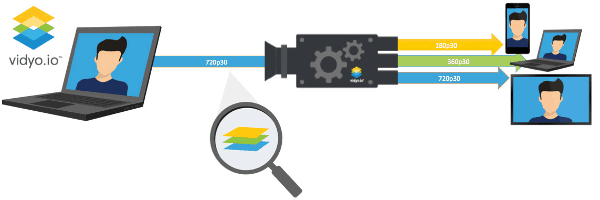
Vidyo has always had its own proprietary codec implementations. Ones that are optimized for SVC - Scalable Video Coding. Alex Eleftheriadis guest posted here last year with an explanation of SVC. To simplify, SVC gives two big advantages:
- Better error resiliency on poor network conditions
- Better support for multiparty and broadcast interactions
- Rely on the browser implementation and exposure of VP9/SVC features, and then implement these capabilities in its application
- Build its own XXX/SVC implementation into a non-browser application
- Browsers prioritize VP9/SVC over other features. The challenge here is that things like aligning with the upcoming WebRTC 1.0 spec is most likely a lot more important
- VP9/SVC will be implemented soon, and controlling its SVC capabilities will be exposed to the developers via JS APIs or additional SDP parameters
- The existence of media servers that support SVC and optimize and fine-tune well for it
Vidyo’s Product Line
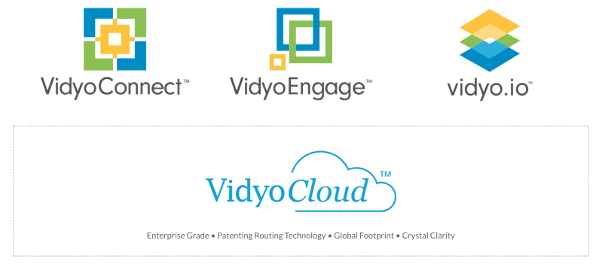
Here’s the gist of the new product live view from Vidyo:
Vidyo has taken the approach of offering a single technical infrastructure to host and run all of its products. This is the right move forward and an embrace of the cloud. In a way, Vidyo is continuing its shift from on premise deployments towards a Vidyo hosted and managed cloud platform.
Vidyo.io can be defined as CPaaS, a Communication Platform as a Service; while its VidyoCloud can be defined as UCaaS, a Unified Communication Platform as a Service.
Vidyo started life in the UC business, moving to the cloud and then adding an API platform. In many other cases, UC / UCaaS vendors take the approach of adding an API on top of their UCaaS product and then just calling it CPaaS. Vidyo decided on “separating” the two which feels to me as the better approach. It casts a wider net over the potential target market and the types of use cases that Vidyo can now cater for.
To this product line, Vidyo has added earlier this year VidyoEngage, its answer to video based contact centers.
The end result? Vidyo can now be used in the 3 biggest domains for visual communications:
- Unified Communications, with its VideoCloud offering; providing a complete video communications platform
- Contact Centers, with VidyoEngage; providing a higher level abstraction of the call center modal to its customers
- All the rest, through its Vidyo.io platform for developers
What’s Next?
The challenge for Vidyo will be in competing in 3 different fronts at the same time, and the threat of losing focus. I am guessing this is one of the reasons for this streamlining - it is meant to simplify its internal infrastructure that is used in these 3 products on the technical level. Managing these separate businesses and keeping abreast in all 3 markets will be hard, but Vidyo is off to a good start here. When it comes to Vidyo.io, the addition of VP9/SVC support positions Vidyo as the technology leader in its space with the ability to offer the best media quality. Its competitors will require more time to close the gap.
Tsahi Levent-Levi
Independent WebRTC analyst. I help companies ship real-time communications they can actually monitor. 20+ years in the comms space, last 13 focused on WebRTC.
More about Tsahi →
Chrome actually supports VP9-SVC. But behind a flag which makes it something you can play with but ... that is about it.
Now that you mention it, there was even a post about it ;-)
https://webrtchacks.com/chrome-vp9-svc/