

What’s in store for WebRTC in 2026? Dive into the trends and predictions, from the rise of video use cases to the influence of Generative AI.
How time flies when you’re having fun… 2025 just started and we’re already in 2026. Time to see what expired with WebRTC throughout 2025 and what comes next in WebRTC in 2026.
For me? I am now back to a freelancer/consultant status full time, with a new project I am building with Philipp Hancke and Olivier Anguenot – rtcstats.com.
If you are interested, you can read my last year’s WebRTC predictions for 2025 😀
Let’s get started here…
Key Takeaways
- WebRTC will see increased integration with Generative AI, shifting focus from human-to-human interactions to AI bot connections
- AV1 adoption will continue, but many vendors might find codec implementations burdensome on device resources
- The trend of WebRTC being utilized in smaller embedded devices will grow, fueled by the rise of voice and video AI
- MOQ will become more relevant in production, but it will not replace WebRTC for interactive sessions
- The overall WebRTC ecosystem may appear stagnant, yet shifts towards AI innovations promise to shape its future
Table of contents
The video version

This year I’ve continued doing the monthly chat with Arin Sime. In November, Arin surprised me by deciding to have our chat around predictions – and doing that without me knowing the questions beforehand or having the time to think it through.
Here’s what my WebRTC predictions for 2025 look like when I am “cornered”:
Read on below to get into the details.
WebRTC predictions 2026: The short version

Here are the questions Arin asked me and the answers I’ve given. Some of it made it to my own predictions below, so read on for the full thought process and details.
1️⃣ WebRTC vs MOQ: Which one will developers complain more about in 2026?
WebRTC. Simply because MOQ isn’t here yet and MOQ is mostly hype, so the people using it today are the early adopters and enthusiasts.
2️⃣ Will AV1 become the dominant video codec in 2026?
No.
3️⃣ Edge computing for WebRTC: Hype or happening?
This is IOT. It happened. It is still happening. But nothing to write home about.
4️⃣ What technology will dispute WebRTC in an unexpected way?
None. Only MOQ can for some use-cases, but it will take time.
5️⃣ What’s one popular WebRTC practice that we will soon consider an anti-pattern?
There’s no one size fits all, which means that silver bullets/patterns don’t work in general. You need to refine your best practices to fit the specific scenario and edge cases you have in your WebRTC application.
Gen AI is eating WebRTC

Call this my overarching theme for 2026. We’ve seen it take place in 2025, and I even titled it “Welcome to the era of Gen AI in WebRTC”.
I think it is a lot more than that though.
In 2025, I can’t remember any single big announcement coming from any of the CPaaS vendors around WebRTC itself.
For me, CPaaS vendors mark the direction of where the market is headed – they cater other developers, so what they do need to appeal to the masses first.
Twilio came back with Twilio Video just before 2025 began, but other than that? Not a single announcement about it that I can remember.
The rest? Minor additions or updates.
And then there was Voice AI and Video AI. These were booming with announcements, resources and effort. We’ve had Daily and LiveKit running head to head when it came to announcing their work on their open source AI framework improvements throughout the year. Stream joined in with their own Vision Agents open source AI framework.
It seems like the path into the future for a lot of WebRTC implementations is going to be paved on top of open source AI frameworks and their managed cloud service by the vendors prompting them.
There were a lot of other creative angles taken when it came to implementing Voice AI by CPaaS vendors (just look at what Cloudflare or Telnyx are doing as examples), but the most successful ones in getting developer mindshare seem to be around the open source AI frameworks at the moment. And again – this is from a developer mindshare point of view – not necessarily end user adoption or $$$.
2026? We will likely see a continuation of this trend. “Desertion” of WebRTC efforts in favor of AI real time media pipelines. Is that still considered WebRTC? Maybe.
Is WebRTC starting to grow in use again?
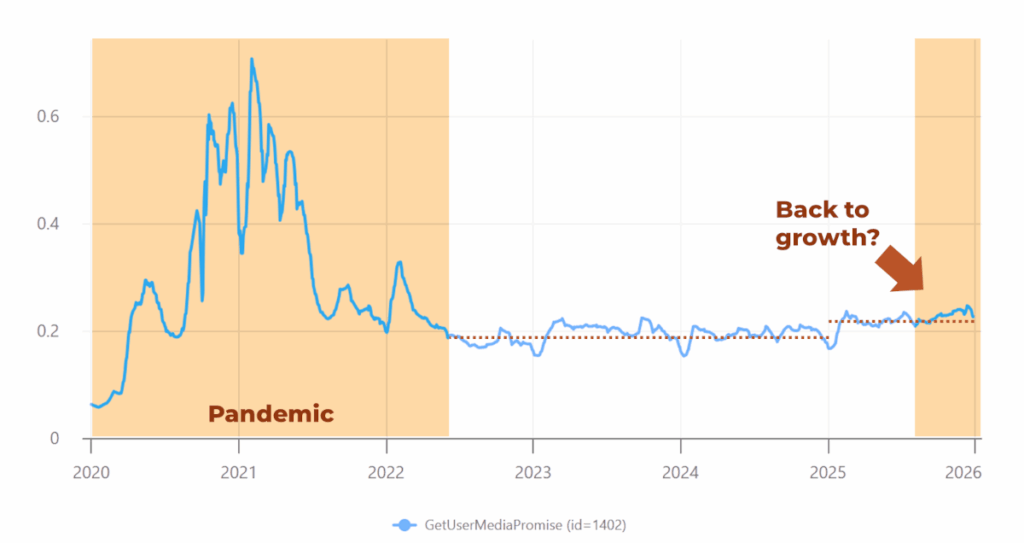
After the pandemic, we’ve had a kind of stagnation in WebRTC adoption. We’ve had 3 consecutive years of 4 times the pre-pandemic usage of WebRTC, when basic our data on getUserMedia() calls in Chrome. There was a slight increase in 2025 in use, with the last 3-4 months showing some more growth. Will this continue or fall back to what we’ve been used for in recent years? We will know in mid-2026.
How did I do with my 2025 WebRTC predictions?

Time to look at how good my 2025 predictions for WebRTC were…
#1 – libWebRTC (and the future of WebRTC)
I opined that libWebRTC will see more of the same, sticking to its house-cleaning mode.

This came out true.
I also mentioned that two things might change in the longer run: either someone other than Google will pick up the mantle of WebRTC or developers will move to the next shiny object in the form of MOQ. I stated both won’t take place in 2025.
Both didn’t come to fruition in 2025. What we did see is a lot more talk and activity around MOQ than ever before. Most of it is still in the form of words and a lot less in the form of concrete plans or real products.
I was spot on here.
#2 – Generative AI
The main show of our industry.
Here’s what I thought:
- LLM will be the main focus, with latencies and pipelining of media being the effort placed in our industry
- Some of it will be in production, but for the most part, this will still be early days
- Voice will be the main theme. A few video attempts will take place
I’d say I was spot on here.
#3 – Audio and video codecs are interesting again
Oops… again.

I missed my prediction about Lyra in 2024, which never happened. It didn’t take place even in 2025.
In 2025 I decided that codecs will be interesting, but somehow said it will be about AV1 and Lyra.
Lyra is nowhere to be found. All focus went to Voice AI and noise cancellation in the cloud before shoving it into speech to text engines… go figure.
For video, I placed my bet on AV1 being adopted more, and HEVC becoming a thing in some areas.
Well… AV1 is being adopted (yay!) and AV2 is starting to be discussed. HEVC is now available in Chrome if there’s hardware acceleration for it, but it still feels in the same abysmal place it was in 2024 when it comes to WebRTC adoption.
A miss for me.
#4 – WebTransport and MOQ will wait a wee bit
Too early for MOQ.

I thought it would be too early in 2025 for these technologies, and it was too early for them.
I’ll take this as a win on my part.
#5 – M&As and shutdowns
Nothing new under the sun was my prediction.

And it turned out to be correct.
Cloudflare acquired Dyte, but then went off after this shiny new toy called MOQ, and GenAI, and everything video. We’ve seen other vendors dialing down their investment, waiting for better days.
A bit less in actual shutdowns.
Around what I was predicting.
WebRTC predictions for 2026

How about discussing what’s up with WebRTC in 2026?
#1 – libWebRTC (and the future of WebRTC)
Nothing new under the sun. libWebRTC will stay in boring house cleaning mode.

In our summary for our 5 years of WebRTC Insights, Philipp Hancke showed the downward trend in issues in libWebRTC. Year over year, there are less issues in that codebase.
Is that because it is more stable or because less is being done?
Here’s what you should expect: 2026 will see the continuation of this, with the number of issues going down a bit further.
WebRTC is now a solid choice for a lot of use cases in browser implementation. Bugs are getting fixed, but new capabilities aren’t introduced much.
I’d like to see more baked into WebRTC, especially to better fit the needs of LLMs (specialized voice codecs or specific networking capabilities that fit bots more than humans). That is unlikely to happen this year.
#2 – Generative AI is eating WebRTC
What happened in 2025 for Generative AI will continue in full force into 2026.

Vendors will invest less in WebRTC communications that are human-to-human, groups or streaming and will focus almost solely on connecting WebRTC to AI bots.
For many CPaaS vendors, the video story of WebRTC is a done deal. There’s work to do there in optimizations (there always will be), but the effort is placed on new use cases to bring new customers and uses. And that lies in connecting to LLMs. The work we’ve seen taking place full force in 2025 will continue well into 2026 across the board.
#3 – AV1
Voice is nice. Video is nicer.
For the past two years, I insisted on having voice codecs improvements as part of my predictions. No more.
It seems Opus is good enough. Lowering audio bitrate seemed like a priority some 3 years ago, but now it feels unnecessary. Why, I don’t know.
There is still work on audio compression and Opus, but it doesn’t seem like WebRTC is involved in it directly.
Video is heading towards AV1 adoption. AV2 is being pushed by the Alliance for Open Media as the next big thing, which will increase the adoption of AV1.
For the time being, I find myself asking vendors who are challenged to dial back down and use VP8, stabilize their implementation and then start experimenting with VP9 and AV1.
Why? Because AV1 is a great video codec that doesn’t fit all devices.
Oh, and VP8 is good enough for the most part. AV1 is better for sure, but is it worth the effort? Will AV2 be worth the effort?
If we look at another set of technologies, desktops have great CPUs. Laptop CPUs aren’t as good. And smartphones… well… don’t get me started.
And yet… Most of our time is spent in front of a smartphone. Because most of us don’t need that excess CPU most of the time.
The same is happening with video codecs. AV1 is great, but it is too expensive in memory and CPU than the alternatives.
This leads us to the cutting edge. If you want to be there, your future is going to be in multi-codec implementations. This means:
- Supporting more than a single codec. Preferable VP8, VP9 and AV1, though other permutations make sense as well
- Ability to switch between video codecs dynamically inside a session when needed
- Supporting more than a single codec at the same time in the same session
You either take that route, or forgo using AV1 for most applications in 2026.
So… what will we see in 2026? More work in getting AV1 to market in WebRTC implementations.
Other codecs – voice or video – will stay roughly the same.
#4 – MOQing around
MOQ will come into production environments, but it won’t replace WebRTC.

2025 was the year of talking about MOQ. 2026 will be the year we start seeing some real POCs of it (we had a few in 2025, but nothing to really write home about).
The thing is, none of it will affect WebRTC. Not in the group or 1:1 calls. And not in live interactive video.
What we will see is an attempt to adopt it where both HLS and WebRTC or HLS and LL-HLS are being used. It will show where we are headed, but it still won’t get there.
Part of the challenge is going to be around the standardization process. It seems like some people want to make MOQ an all-encompassing protocol that will solve all of our problems. Taking that route is going to slow down standardization and adoption. And it will make implementations a lot more complicated, ruining part of the promise of MOQ as a solution.
As I mentioned in my video with Arin, MOQ is either going to be something that crazy startups will do or large vendors with the headcount to experiment with it before deploying it.
For most of my readers, MOQ isn’t the way to go in 2026 yet.
#5 – Embedded devices
I’ll skip my M&A and shutdowns prediction. It is boring (same as last year). What I want to highlight instead is that WebRTC is going downstream towards ever smaller devices.

As a point in question, let’s look at the ESP32 chip: “a family of low-cost, energy-efficient microcontrollers that integrate both Wi-Fi and Bluetooth capabilities”. It has a billion or more devices deployed already, so something to reckon with.
And yes, it has a WebRTC implementation available for it with vendors officially supporting it (Daily and LiveKit both had announcements/demos around it this last quarter).
Then there’s the Matter 1.5 protocol for IOT devices, which introduced support for camera streaming done over WebRTC. Samsung already announced support for it.
WebRTC is now becoming something that isn’t solely browser based, where it started life, but rather something that can be used everywhere. It was always the case, but now we see signs of other standards and embedded devices picking it up.
Arin called these Edge devices, or IOT devices. For me, this is just going into the domain of embedded devices that aren’t a desktop, laptop, tablet or smartphone.
In 2026 we will see rising interest and adoption of WebRTC in more and more embedded devices. It will be driven due to the need of introducing more voice and video AI without going through a human’s personal device and because things need to be interactive and live.
2026 is here

2026 is now starting. If you’re doing what you did last year, it might not be enough. Or it is, but you may need to fine tune it a bit.
Things seem to be shifting quickly around Generative AI while the rest of the WebRTC ecosystem seems stagnated. But this isn’t the case. Not really.
Contact me

My focus is still around WebRTC and developers.
And my services this year are going to have this focus:
- Consulting – helping vendors optimizing their media quality and connectivity, figuring out roadmaps, deciding on strategy, building their teams
- WebRTC Insights – for those who want to keep ahead of WebRTC bugs and trends, this is the best way
- rtcStats – the new thing I started with Olivier and Philipp. It is the fastest way to troubleshoot and debug WebRTC sessions. And it is free (and open source and freemium and commercial)
Besides these, I will be doing more focused content creation on LinkedIn and YouTube, so be sure to follow me there (most of what’s there doesn’t end up in articles here). And if you aren’t already subscribed to WebRTC Weekly, this is a good time as ever to get informed on what’s happening in WebRTC around you on the market.
See you around in 2026!